






















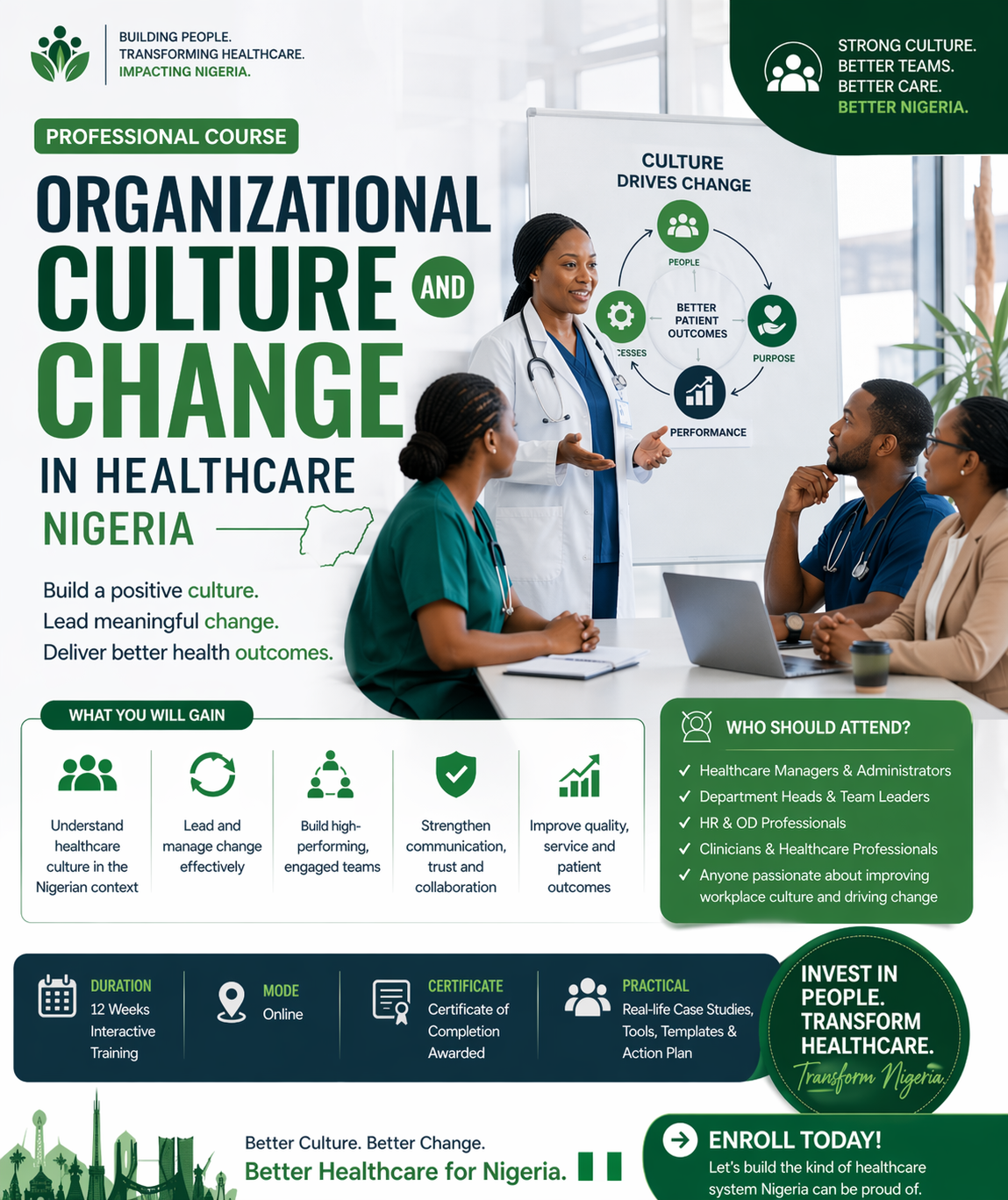
Organisational Culture & Change in Healthcare

Organisational Culture & Change in Healthcare

Featured
Bestseller
This course interrogates the interplay between organizational culture and change within complex healthcare systems. It examines how deeply embedded norms, values, and power structures shape clinical outcomes, patient safety, workforce behaviour, and institutional performance. Students will engage with theoretical models, empirical case studies, and applied frameworks to design, implement, and evaluate sustainable change in healthcare environments.
0 Students
23 Lectures

About This Course

This course provides a rigorous, practice-oriented examination of organizational culture and change within healthcare systems, equipping participants with advanced competencies required for leadership, quality improvement, and system transformation.

Aligned with Continuing Professional Development (CPD) expectations and Nigerian healthcare competency frameworks, the course develops the knowledge, skills, and professional behaviours necessary to diagnose, influence, and redesign organizational culture in complex clinical and administrative environments.

Students will acquire the ability to integrate theory, evidence, and applied methods to improve patient safety, workforce performance, and institutional effectiveness across public and private healthcare settings.


CPD Alignment

This course is structured to meet CPD requirements across three domains:

1. Knowledge (Cognitive Competence)

Participants will:

  • Demonstrate advanced understanding of organizational culture theories, including frameworks developed by Edgar Schein and Robert E. Quinn

  • Analyse the relationship between culture, leadership, and patient safety outcomes

  • Critically evaluate change management models, including those proposed by Kurt Lewin and John Kotter


2. Skills (Applied/Practical Competence)

Participants will be able to:

  • Conduct structured cultural diagnostics using validated tools and mixed-method approaches

  • Identify and analyse barriers to change across clinical, organizational, and policy contexts

  • Design and implement evidence-based change interventions tailored to healthcare environments

  • Apply leadership strategies that promote psychological safety, effective communication, and interdisciplinary collaboration


3. Professional Behaviour (Reflective & Ethical Practice)

Participants will:

  • Demonstrate reflective practice in evaluating organizational culture and leadership behaviour

  • Promote ethical, patient-centred approaches to organizational change

  • Foster cultures of transparency, accountability, and continuous improvement


Nigerian Health System Competency Alignment

This course aligns with key competency domains relevant to institutions such as Federal Ministry of Health Nigeria and National Primary Health Care Development Agency, as well as broader workforce expectations across NigeriaG

FAQ

Check the frequently asked questions about this course.

1. What is this course about?
This course examines how organizational culture shapes behaviour, decision-making, and outcomes within healthcare systems. It equips participants with the analytical tools and practical frameworks required to diagnose cultural dynamics and lead effective, sustainable change in clinical and administrative environments.
2. What will I learn from this course?
You will learn to: 1. Analyse organizational culture using frameworks developed by Edgar Schein and Robert E. Quinn 2. Diagnose cultural strengths, weaknesses, and misalignments in healthcare settings 3. Understand how culture impacts patient safety, workforce behaviour, and system performance 4. Identify and manage resistance to change 5. Apply structured change models such as those proposed by Kurt Lewin and John Kotter 6. Design and implement culture-driven transformation initiatives
3. Who is this course for?
This programme is designed for: 1. Healthcare professionals (doctors, nurses, allied health staff) 2. Hospital administrators and managers 3. Public health practitioners 4. Policymakers and government officials 5. Health system consultants and development partners It is suitable for both clinical and non-clinical professionals involved in healthcare delivery and reform.
4. Do I need prior knowledge to take this course?
No prior formal training in organizational theory is required. However, familiarity with healthcare environments, clinical, administrative, or policy, is strongly beneficial for applying the concepts effectively.
5. Is the course accredited?
Yes. The course is structured to align with Continuing Professional Development (CPD) standards and is designed for recognition by relevant professional bodies. It also aligns with competency expectations within institutions such as: Federal Ministry of Health Nigeria National Primary Health Care Development Agency Formal accreditation partnerships can be extended where required.
6. How is the course structured?
The programme is delivered across three certification levels: Level 1: Foundations of Organizational Culture Level 2: Applied Culture Diagnosis and Change Level 3: Executive Leadership and System Transformation Each level builds progressively from theory to application to strategic leadership.
7. How long does it take to complete the course?
1. Level 1: 20G
8. What is the mode of delivery?
The course is delivered fully online via Rated Academy, including: 1. Pre-recorded lecture sessions 2. Downloadable lecture notes 3. Case studies and assignments Optional live sessions and masterclasses
9. How will I be assessed?
Assessment is competency-based and includes: 1. Knowledge tests 2. Written assignments 3. Case study analysis 4. Practical change design projects 5. A capstone project (Level 3) The focus is on real-world application, not rote learning.
10. What certification will I receive?
Participants receive: 1. Certificate (Level 1) 2. Advanced Certificate (Level 2) 3. Executive Diploma in Organizational Culture and Change in Healthcare (Level 3) All certificates are issued by Rated Academy.
11. How is this course relevant to NigeriaG
The course is specifically contextualised for Nigeria, addressing: 1. Public hospital systems 2. Primary healthcare delivery challenges 3. Workforce and governance issues 4. Policy implementation realities It aligns with national priorities and institutional frameworks within the Nigerian health sector.
12. Will this course help me in my current role?
Yes, directly. Participants gain tools to: 1. Improve team performance 2. Address communication breakdowns 3. Enhance patient safety 4. Lead change initiatives within their organization The course is designed for immediate workplace application.
13. Can organizations enrol teams or cohorts?
Yes. Rated Academy offers: 1. Institutional enrolment packages 2. Customised delivery for hospitals and agencies 3. Cohort-based learning for teams This is particularly valuable for: 1. Health ministries 2. Hospital networks 3. Development programmes
14. What makes this course different from others?
Most healthcare training focuses on: 1. Clinical skills 2. Policy compliance 3. Technical systems This course focuses on: The cultural drivers behind success or failure in healthcare systems. It integrates: 1. Global theory 2. Real-world application 3. Nigerian system realities
15. Will I need to complete a project?
Yes, at Level 3. The capstone project requires you to: 1. Diagnose a real organizational culture 2. Design a change intervention 3. Present a structured implementation plan This ensures you graduate with demonstrable impact capability.
16. Is the course suitable for senior leaders?
Yes. Level 3 is specifically designed for: 1. Executives 2. Policymakers 3. Senior managers It focuses on: 1. System-level transformation 2. Governance 3. Strategic leadership
17. How does this course support career progression?
This programme strengthens: 1. Leadership capability 2. Strategic thinking 3. Systems understanding It positions participants for roles in: 1. Healthcare management 2.Policy leadership 3. Programme design 4. Organizational consulting
18. How do I enrol?
Enrolment is completed through Rated AcademyG
19. Is there support during the course?
Yes. Participants have access to: 1. Learning support materials 2. Facilitator guidance (where applicable) 3. Peer interaction (for cohort-based delivery)
20. What outcomes can I expect after completing the course?
1. Diagnose organizational culture with precision 2. Understand the root causes of systemic failure 3. Design and implement effective change strategies 4. Lead cultural transformation in healthcare environments
Closing Note
This course is not designed to produce passive learners. It is designed to produce: Practitioners capable of transforming healthcare systems by reshaping the cultures that drive them.
Ako N'Uche Onyenkuzi
2 Courses
0 Students
Dynamic and results-driven executive with over 25 years of international experience in Information Technology, Business Strategy, and Enterprise Consulting across Europe, Asia, and Africa. With a strong foundation in Geography and Regional Planning, I have successfully led and delivered strategic IT projects for global corporations and public sector organisations across diverse industries including Government, Telecommunications, Energy, Financial Services, Retail, Academia, and Healthcare. Highly skilled in programme management, innovation strategy, and value engineering, I specialise in helping organisations design and implement technology-driven transformation initiatives that align with ...
Curriculum Overview

This course includes 12 modules, 23 lessons, and 8:55 hours of materials.

Lecture 1 - Introduction to Organizational Culture in Healthcare
3 Parts | 0:40 Hours
Introduction to Organizational Culture in Healthcare

Let us begin with a proposition that may appear self-evident, yet remains profoundly misunderstood in practice: Healthcare systems do not fail primarily because of a lack of knowledge. They fail because of the cultures within which that knowledge is applied.

Study Duration 40 Minutes
Attachments 0
LECTURE 1 QUIZ G

Healthcare systems do not fail primarily because of a lack of knowledge. They fail because of the cultures within which that knowledge is applied.

Questions 4
Duration 10 Minutes
Passing Grade 100/400
Total Grade 400
Attempts 0/2
LECTURE 2 QUIZ G

Patient safety is not primarily a technical problem. It is a cultural one.

Questions 4
Duration 10 Minutes
Passing Grade 100/400
Total Grade 400
Attempts 0/2
Lecture 2 - Theoretical Frameworks of Organizational Culture in Healthcare
1 Parts | 0:40 Hours
Theoretical Frameworks of Organizational Culture in Healthcare

In the previous lecture, we established that organizational culture is not peripheral to healthcare performance, it is central to it. Today, we advance from conceptual grounding to analytical instrumentation.


Put differently: if Lecture 1 asked what culture is, Lecture 2 asks: How do we rigorously analyse it?


Because without analytical clarity, any attempt at cultural transformation is reduced to rhetoric.

Study Duration 40 Minutes
Attachments 0
Lecture 3 - Culture and Patient Safety in Healthcare
1 Parts | 0:45 Hours
Culture and Patient Safety in Healthcare

We now arrive at the point where the abstraction of organizational culture meets the hard edge of clinical reality.


Let us begin with a statement that must be taken not as rhetoric, but as empirical fact: Patient safety is not primarily a technical problem. It is a cultural one.

Study Duration 45 Minutes
Attachments 0
Lecture 4 - Leadership and Cultural Dynamics in Healthcare
2 Parts | 0:45 Hours
Leadership and Cultural Dynamics in Healthcare

If organizational culture determines how healthcare systems behave, then we must now confront the mechanism through which culture is most powerfully shaped:
Leadership.

Study Duration 45 Minutes
Attachments 0
LECTURE 3 QUIZ G

Leadership in healthcare is not defined by position. It is defined by influence over culture.

Questions 4
Duration 10 Minutes
Passing Grade 1/400
Total Grade 400
Attempts 0/2
Lecture 5 - Diagnosing Organisational Culture in Healthcare Systems
2 Parts | 0:45 Hours
Diagnosing Organisational Culture in Healthcare Systems

In our previous lectures, we examined the architecture of organisational culture, how it forms, how it persists, and how it shapes behaviour across healthcare systems. Today, we shift from theory to disciplined inquiry.


Because before culture can be changed, it must first be diagnosed.


And here is the central proposition for today: Most healthcare organisations do not fail to change because they lack solutions, they fail because they misdiagnose their own culture.

Study Duration 45 Minutes
Attachments 0
LECTURE 4 QUIZ G

Most healthcare organisations do not fail to change because they lack solutions, they fail because they misdiagnose their own culture.

Questions 3
Duration 10 Minutes
Passing Grade 100/300
Total Grade 300
Attempts 0/2
Lecture 6 - Designing and Implementing Culture Change in Healthcare Systems
2 Parts | 0:45 Hours
Designing and Implementing Culture Change in Healthcare Systems

In the previous lecture, we established a rigorous approach to diagnosing organisational culture. We concluded with a critical insight: You cannot change what you have not accurately understood.

Study Duration 45 Minutes
Attachments 0
LECTURE 5 QUIZ G

How do you deliberately change organisational culture in a healthcare system without triggering resistance, collapse, or superficial compliance?

Questions 3
Duration 10 Minutes
Passing Grade 100/300
Total Grade 300
Attempts 0/2
Lecture 7 - Power, Politics, and Resistance in Healthcare Organisations
1 Parts | 0:45 Hours
Power, Politics, and Resistance in Healthcare Organisations

Up to this point, our discussion of organisational culture and change has been methodologically rigorous, but still, in some respects, idealised.

Study Duration 45 Minutes
Attachments 0
Lecture 8 - Patient Safety Culture and High-Reliability Healthcare Organisations
3 Parts | 0:50 Hours
Patient Safety Culture and High-Reliability Healthcare Organisations

In todayG

Study Duration 50 Minutes
Attachments 0
LECTURE 6 QUIZ G

Patient safety culture is the set of shared values, beliefs, and behavioural norms that determine how an organisation identifies, reports, analyses, and learns from safety risks.

Questions 3
Duration 10 Minutes
Passing Grade 100/300
Total Grade 300
Attempts 0/2
LECTURE 8 QUIZ G

Modern healthcare systems, despite their sophistication, remain inherently hazardous environments.

Questions 3
Duration 10 Minutes
Passing Grade 100/300
Total Grade 300
Attempts 0/2
Lecture 9 - Measuring Organisational Culture and Change in Healthcare
1 Parts | 0:45 Hours
Measuring Organizational Culture and Change

We now arrive at one of the most technically challenging aspects of organisational culture and change: This is where we impose analytical discipline on everything weG

Study Duration 45 Minutes
Attachments 0
Lecture 10 - Sustaining Culture Change and Building Adaptive Healthcare Organisations.
4 Parts | 0:45 Hours
Sustaining Culture Change and Building Adaptive Healthcare Organisations.

This is the capstone of this course. Everything we have examined, culture, diagnosis, power, safety, measurement, now converges into a single, demanding question:


How do you make culture change last in healthcare systems that are under constant pressure, perpetual reform, and structural instability?

Study Duration 45 Minutes
Attachments 0
LECTURE 7 QUIZ G

Sustainable culture change is not an outcome, it is a capability.

Questions 3
Duration 10 Minutes
Passing Grade 100/300
Total Grade 300
Attempts 0/2
LECTURE 9 QUIZ G

Sustainable culture change is not an outcome, it is a capability.

Questions 3
Duration 10 Minutes
Passing Grade 100/300
Total Grade 300
Attempts 0/2
LECTURE 10 QUIZ G

How do you make culture change last in healthcare systems that are under constant pressure, perpetual reform, and structural instability?

Questions 3
Duration 10 Minutes
Passing Grade 100/300
Total Grade 300
Attempts 0/2
Case Study
2 Parts | 0:45 Hours
Case Study - Safety Incident: Wrong-Site Surgery in a Tertiary Hospital

At a large teaching hospital, a patient is scheduled for right knee arthroscopy following a sports injury. Due to a sequence of breakdowns, the surgical team performs the procedure on the left knee.


The error is only discovered post-operatively when the patient regains consciousness and reports persistent pain in the untreated right knee.

Study Duration 45 Minutes
Attachments 0
Case Question

A Nigerian teaching hospital introduces multiple reforms, digital systems, new policies, and leadership changes, but outcomes remain unchanged.

Questions 1
Duration 15 Minutes
Passing Grade 100/100
Total Grade 100
Attempts 0/
Teaching Case Study
1 Parts | 0:45 Hours
Case Title: The Silent Checklist: A Wrong-Site Surgery Incident

1. Case Narrative (For Learners)


A 42-year-old male patient presents to a tertiary hospital for elective right knee arthroscopy following a ligament injury sustained during recreational football.


During preoperative preparation:
The consent form clearly states right knee.
The electronic theatre list, however, incorrectly lists left knee due to a clerical entry error.


On the day of surgery:
A junior doctor is asked to mark the surgical site due to the consultant surgeonG

Study Duration 45 Minutes
Attachments 0
Certificates
12 Parts
Certificate
Assessment Certificate
You will receive this certificate after passing the “LECTURE 2 QUIZ GZ” assessment.
Type Assessment Certificate
Passing Grade 100/400
Certificate
Assessment Certificate
You will receive this certificate after passing the “LECTURE 1 QUIZ GZ” assessment.
Type Assessment Certificate
Passing Grade 100/400
Certificate
Assessment Certificate
You will receive this certificate after passing the “LECTURE 3 QUIZ GZ” assessment.
Type Assessment Certificate
Passing Grade 1/400
Certificate
Assessment Certificate
You will receive this certificate after passing the “LECTURE 4 QUIZ GZ” assessment.
Type Assessment Certificate
Passing Grade 100/300
Certificate
Assessment Certificate
You will receive this certificate after passing the “LECTURE 5 QUIZ GZ” assessment.
Type Assessment Certificate
Passing Grade 100/300
Certificate
Assessment Certificate
You will receive this certificate after passing the “LECTURE 6 QUIZ GZ” assessment.
Type Assessment Certificate
Passing Grade 100/300
Certificate
Assessment Certificate
You will receive this certificate after passing the “LECTURE 7 QUIZ GZ” assessment.
Type Assessment Certificate
Passing Grade 100/300
Certificate
Assessment Certificate
You will receive this certificate after passing the “LECTURE 8 QUIZ GZ” assessment.
Type Assessment Certificate
Passing Grade 100/300
Certificate
Assessment Certificate
You will receive this certificate after passing the “LECTURE 9 QUIZ GZ” assessment.
Type Assessment Certificate
Passing Grade 100/300
Certificate
Assessment Certificate
You will receive this certificate after passing the “LECTURE 10 QUIZ GZ” assessment.
Type Assessment Certificate
Passing Grade 100/300
Certificate
Assessment Certificate
You will receive this certificate after passing the “Case QuestionZ” assessment.
Type Assessment Certificate
Passing Grade 100/100
Course Certificate
Course Certificate
If you pass all the lessons in this course, you will receive this certificate.
Type Course Certificate
Reply to Comment
Comments Approval

Your comment will be visible after admin approval.

0
0 Reviews
Content Quality (0)
Instructor Skills (0)
Value for Money (0)
Support Quality (0)
Reply to Review
Submit Reply

Your reply to this review will be visible to all users.

Organisational Culture & Change in Healthcare
Select a Pricing Plan
$68.69
Buy with 10 points Subscribe

This Course Includes

11 Online Quiz(zes)
Official Certificate
Course Forum

Course Specifications

Sections
12
Lessons
23
Capacity
500 Students
Duration
5:00 Hours
Students
0
Access Duration
90 Days
Created Date
23 Apr 2026
Updated Date
15 May 2026
Organisational Culture & Change in Healthcare
You are viewing
Organisational Culture & Change in Healthcare
https://ola62.com/ https://ats.io.vn// https://nabtah.net/contacts https://www.ircf.uk/